

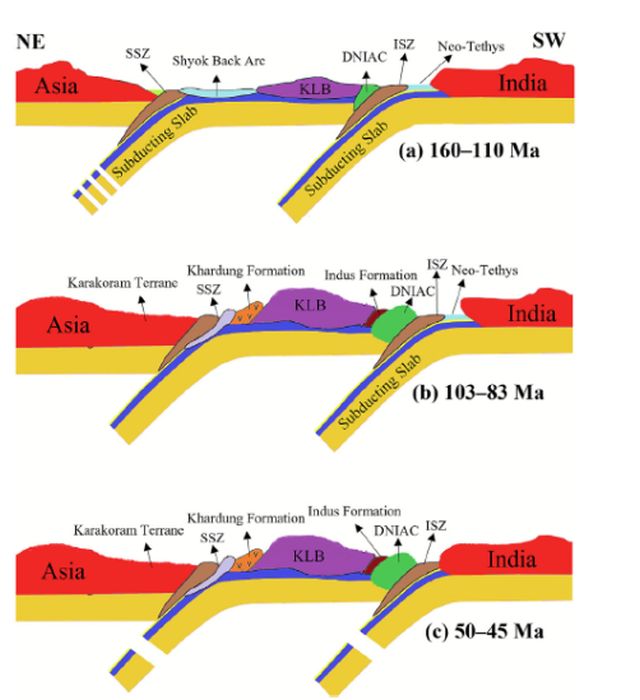
The research focuses on understanding the origin and development of the Ladakh magmatic arc, which formed due to subduction-related tectonic activity prior to the collision between the Indian and Eurasian plates.
According to the study, the magmatic arc developed as a result of the subduction of the Neo-Tethys Oceanic Plate beneath the Eurasian Plate. This led to extensive magmatism and the formation of igneous rocks that now constitute a significant part of the Ladakh region.
The findings suggest that the evolution of the magmatic arc played a crucial role in the early stages of Himalayan orogeny, contributing to crustal growth and the eventual uplift of the mountain range.
The study also highlights variations in magma composition and timing, providing important clues about tectonic processes and the geodynamic evolution of the northwestern Himalaya.
These insights are expected to enhance scientific understanding of mountain-building processes and improve models related to plate tectonics and continental evolution.