

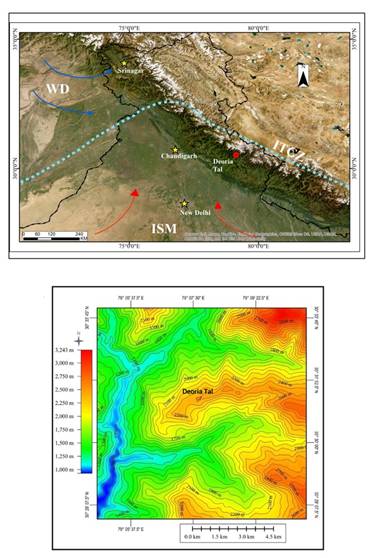
Researchers examined fossil pollen grains deposited over thousands of years to reconstruct past vegetation and climate patterns across the northwestern Indian subcontinent. Since different plant species produce distinct pollen, these microscopic grains serve as natural archives, helping scientists understand changes in rainfall, temperature and land use over time.
The findings indicate that the Harappan Civilization did not collapse suddenly but underwent a gradual transformation driven largely by shifts in the climate. A weakening of the Indian summer monsoon led to reduced rainfall, affecting agriculture and water availability. As environmental conditions became less favourable, urban centres began to shrink and populations gradually dispersed towards regions with more reliable water resources.
The pollen record revealed a transition in vegetation from moisture-loving plant species to those better adapted to drier conditions, confirming a prolonged phase of increasing aridity. These environmental changes likely reduced agricultural productivity, making it difficult to sustain large cities and extensive trade networks.
The study supports the growing scientific consensus that climate change, rather than a single catastrophic event, played a crucial role in reshaping the Harappan Civilization. Instead of disappearing abruptly, Harappan communities adapted by changing settlement patterns, agricultural practices and livelihoods.
Researchers believe the findings demonstrate the importance of palaeobotanical evidence such as fossil pollen in reconstructing ancient environments and understanding the relationship between climate and human societies. The research also offers valuable lessons for the modern world, highlighting how long-term environmental changes can influence settlement patterns, food security and the resilience of civilizations.
The study adds an important chapter to the understanding of the Harappan Civilization, showing that microscopic pollen grains can provide powerful clues about the environmental history that shaped one of South Asia’s greatest ancient cultures.